Robbin Juris
Robbin Juris studied surface and textile design at Fashion Institute of Technology and ceramics at Chelsea Ceramics Guild, after attending graduate school in English literature at Columbia University. She began showing her artwork at the age of 17, having been selected to participate in a group exhibition at Lever House in New York City. She has had a solo show of raku-fired ceramic vessels at the Chelsea Ceramics Guild Gallery and several solo shows of prints at the Treetops Chamber Music Society. Her print entitled "The Center Cannot Hold" was chosen by Ann Coffin, founder and director of International Print Center New York, to be included in the 2nd Biennial Footprint International Exhibition at Center for Contemporary Printmaking. She was a finalist in the Hammond Museum's 2010 Tri-State Competition for Emerging Artists. Several of her prints were selected to be included in ASCI's DIGITAL2011: The Alchemy of Change, an exhibit celebrating the Year of Chemistry at the New York Hall of Science. In addition to her work as an artist, Robbin has had a multifaceted career as a magazine editor, including managing the news section of PC Magazine. Here she developed a strong interest in using computers as a medium for printmaking.

The unifying theme of Robbin's work is infinity as it is expressed in the complex patterns and dynamic processes of the natural world. In two series of prints, both of which were inspired by the myth of Daedalus, the theme of infinity comes into play through the metaphor of the labyrinth. In the In/Finite Maze series, the starting points for her labyrinths are maze algorithms and cellular automata, which she uses to create imaginal spaces that may continue to infinity randomly or may repeat in a pattern too large to be immediately—or ever—comprehensible. The behavior of these labyrinths fluctuates between two seemingly contradictory yet interdependant states: apparent randomness/chaos and order. The viewer may have the experience of being both inside and outside of these labyrinths, as if, in the words of William James, “ the opposites of the world, whose contradictoriness and conflict make all our difficulties and troubles, were melted into unity.”

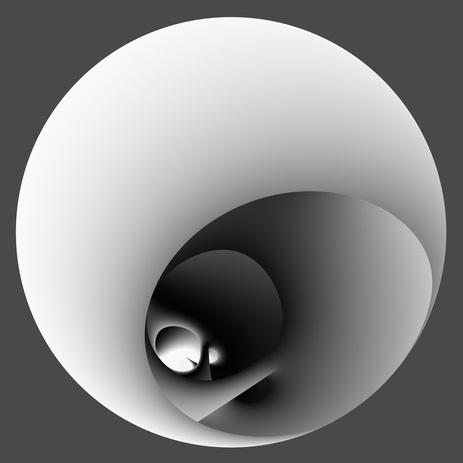
In the series You Are Here, You Are Here, You Are Here,..., Robbin uses the infinitely recursive properties of fractal geometry as source material. These images of projective spheres reflect her view of the world as an infinite labyrinth. Again in the words of William James, they “open a region though they fail to give a map.” These prints share in common shapes that preserve their detailed structure in all scales. Thus, what viewers see on the surface of one of these prints is also what they might see if they could zoom into the print in real time. Paradoxically, the surface smoothness of the spheres belies their inherent roughness and irregularity, which may become apparent at other angles of observation.

Much of Robbin's work explores the place where order and disorder meet—apparent oppositions that point to uncertainty and unpredictability in nature. Yet she is also intrigued by instances when nature effects change to seek order, such as when atoms with incomplete shells add or lose electrons to gain stability, in the process becoming ions. Her I(c)onic Bonds series is meant to evoke the polarity and complementarity between change and changelessness; each requires the other. The series is a visual interpretation of the transfer of electrons between oppositely charged atoms. Black and white are proxies for negative and positive; shades of gray and blurriness are meant to convey the dynamic process of electromagnetic attraction. It is paradoxical that as this change from instability to stability takes place, uncertainty reenters the picture: It is impossible to determine simultaneously the location and the momentum of the electrons.

In other work, Robbin examines the transformative effects of forces such as wave patterns and turbulence on universal forms. And in her photographic prints, she focuses on the concept of simultaneity, with blurred boundaries, intersections, and overlaps. Themes that recur in Robbin’s work include the interplay between chaos and order and the mysterious relationships among forms in nature.

Originally from New York City, Robbin lives in Stamford, Connecticut, with her husband and their two sons.

Website Builder